RcloneView vs AzCopy: Multi-Cloud GUI vs Azure CLI Tool
AzCopy is Microsoft's CLI tool for Azure Blob and Azure Files transfers. RcloneView is a multi-cloud GUI that supports Azure alongside 70+ other providers. Here is how they compare.
AzCopy is purpose-built for moving data into, out of, and between Azure storage accounts. It handles Azure Blob Storage, Azure Files, and Azure Data Lake Storage Gen2 with tight integration into Azure Active Directory and SAS token authentication. RcloneView takes a different approach — it connects to Azure as one of many supported providers and manages transfers through a visual interface. The right choice depends on whether your workflow is Azure-only or multi-cloud.
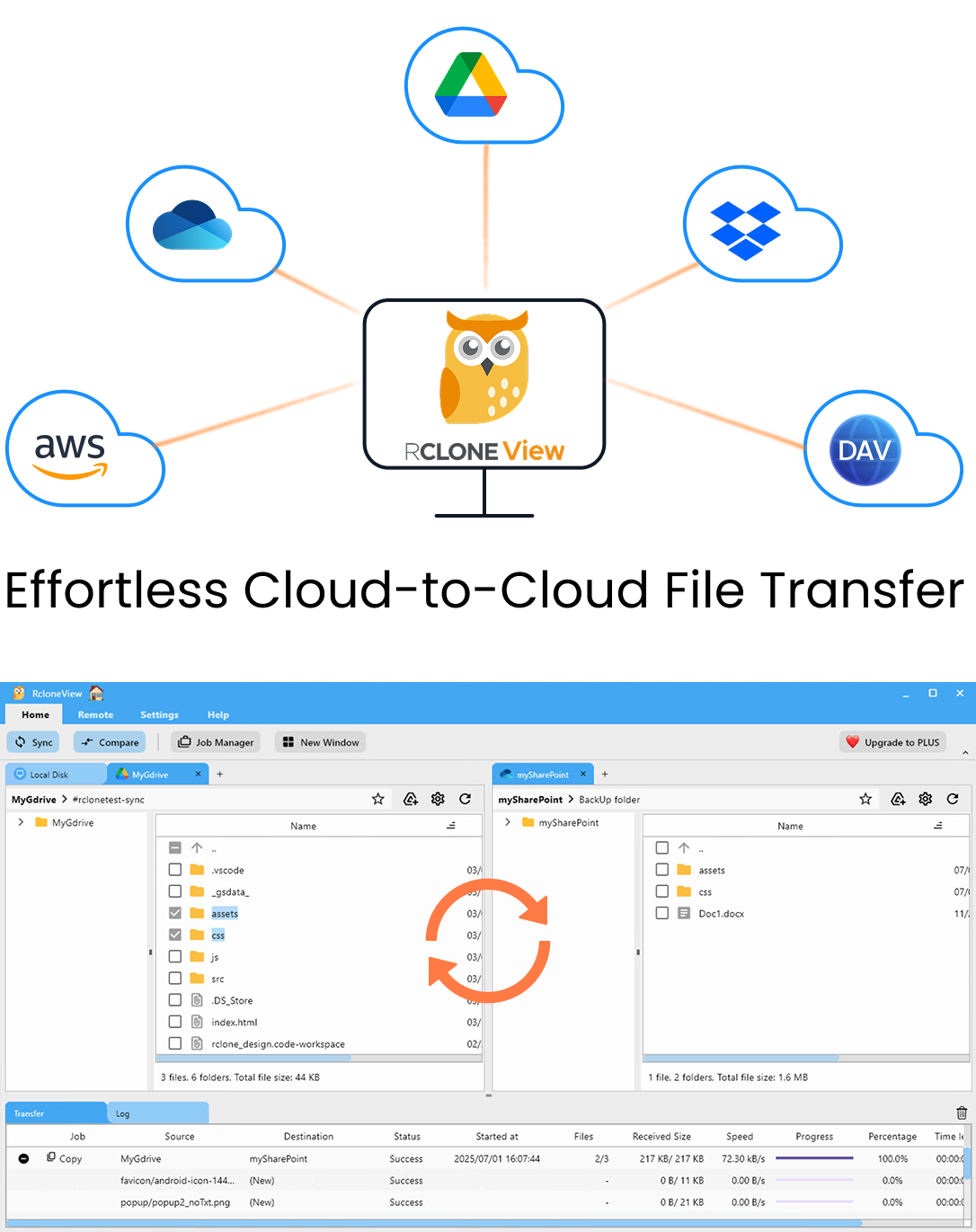
Manage & Sync All Clouds in One Place
RcloneView is a cross-platform GUI for rclone. Compare folders, transfer or sync files, and automate multi-cloud workflows with a clean, visual interface.
- One-click jobs: Copy · Sync · Compare
- Schedulers & history for reliable automation
- Works with Google Drive, OneDrive, Dropbox, S3, WebDAV, SFTP and more
Free core features. Plus automations available.
Provider Support
AzCopy supports Azure Blob Storage, Azure Files, Azure Data Lake Storage Gen2, and Amazon S3 (as a source for copying to Azure). It does not support Google Drive, Dropbox, OneDrive, Backblaze B2, or any other non-Azure provider as a destination.
RcloneView supports 70+ providers including Azure Blob Storage, Azure Files, Google Drive, OneDrive, Dropbox, AWS S3, Backblaze B2, Cloudflare R2, SFTP, WebDAV, and many more. If you manage data across multiple cloud providers, RcloneView eliminates the need for multiple transfer tools.
Interface
AzCopy is a command-line tool. Every operation requires constructing a command with flags, SAS tokens or Azure AD credentials, and source/destination URLs. There is no GUI — you work entirely in a terminal.
RcloneView provides a visual two-pane file explorer. Browse Azure Blob containers alongside Google Drive, drag and drop files between providers, and configure sync jobs through dialog boxes. The GUI makes it accessible to users who are not comfortable with CLI operations, while a built-in terminal is available for advanced users who want direct rclone command access.
Authentication
AzCopy supports Azure Active Directory (OAuth 2.0), SAS tokens, and service principals. It integrates with az login and supports managed identities on Azure VMs. For Azure-to-Azure transfers, it can use server-side copy with no data passing through your machine.
RcloneView supports SAS tokens and account keys for Azure Blob and Azure Files. For Azure AD authentication, you configure the credentials in the remote setup. While RcloneView does not integrate with az login directly, it stores credentials securely in the rclone configuration file with optional encryption.
Transfer Performance
AzCopy is optimized for Azure transfers. It supports parallel operations, automatic retry, and server-side copy between Azure accounts (data moves within Azure's network without touching your machine). For Azure-to-Azure migrations, this is significantly faster than any tool that routes data through a local machine.
RcloneView routes data through your machine for all transfers, including Azure-to-Azure. However, it offers multi-threaded transfers, configurable chunk sizes, bandwidth limits, and resumable uploads. For transfers between Azure and non-Azure providers, performance is comparable. For Azure-to-Azure transfers, AzCopy's server-side copy has a clear advantage.
Sync and Scheduling
AzCopy supports azcopy sync with delete detection based on last-modified timestamps. Scheduling requires external tools like cron or Windows Task Scheduler.
RcloneView provides sync, copy, and move operations with built-in scheduling. Configure a recurring job with a visual scheduler — no external tools needed. The job history panel logs every run with detailed statistics.
Monitoring
AzCopy outputs progress to the terminal and writes log files. You can check job status with azcopy jobs list and azcopy jobs show.
RcloneView provides a real-time monitoring dashboard with per-file progress, transfer speed graphs, and overall completion percentage. You can pause, resume, or cancel individual transfers from the GUI.
Feature Comparison Table
| Feature | RcloneView | AzCopy |
|---|---|---|
| GUI interface | Yes | No (CLI only) |
| Azure Blob support | Yes | Yes |
| Azure Files support | Yes | Yes |
| Non-Azure providers | 70+ providers | S3 (source only) |
| Server-side Azure copy | No | Yes |
| Azure AD authentication | Via config | Native |
| Built-in scheduling | Yes | No (requires cron) |
| Real-time monitoring GUI | Yes | No (terminal output) |
| Mount as local drive | Yes | No |
| Encryption (crypt) | Yes | No |
| Bandwidth throttling | Yes | Yes |
| Resume failed transfers | Yes | Yes |
When to Choose Each Tool
Choose AzCopy when:
- Your workflow is Azure-only (Azure Blob ↔ Azure Blob).
- You need server-side copy between Azure accounts for maximum speed.
- You require Azure AD/managed identity authentication on Azure VMs.
- You are scripting transfers in CI/CD pipelines that only touch Azure.
Choose RcloneView when:
- You manage data across Azure and other providers (Google Drive, S3, Dropbox, etc.).
- You prefer a GUI over command-line operations.
- You need built-in scheduling, monitoring, and job history.
- You want to mount Azure storage as a local drive.
- You need client-side encryption with crypt remotes.
Getting Started with RcloneView
- Download RcloneView from rcloneview.com.
- Add your Azure Blob or Azure Files remote in the Remote Manager.
- Browse your Azure containers alongside other cloud providers in the two-pane explorer.
- Set up sync jobs with built-in scheduling and monitoring.
AzCopy excels at Azure-to-Azure transfers with server-side copy and Azure AD integration. RcloneView provides a broader multi-cloud solution with a visual interface, built-in scheduling, and support for 70+ providers. For teams managing data beyond Azure, RcloneView eliminates the need for multiple specialized tools.
Related Guides:
Supported Cloud Providers