RcloneView vs S3 Browser: Multi-Cloud GUI vs S3 File Manager
S3 Browser is a Windows GUI for managing Amazon S3 and S3-compatible storage. RcloneView is a cross-platform multi-cloud GUI supporting S3 alongside 70+ other providers. Here is how they compare.
S3 Browser is a dedicated Windows application for browsing, managing, and transferring files to Amazon S3 and S3-compatible services like Wasabi, Backblaze B2, and MinIO. RcloneView connects to S3 as one of many supported backends and extends its capabilities to Google Drive, OneDrive, Dropbox, SFTP, and dozens of other providers — all through a visual two-pane explorer that runs on Windows, macOS, and Linux.
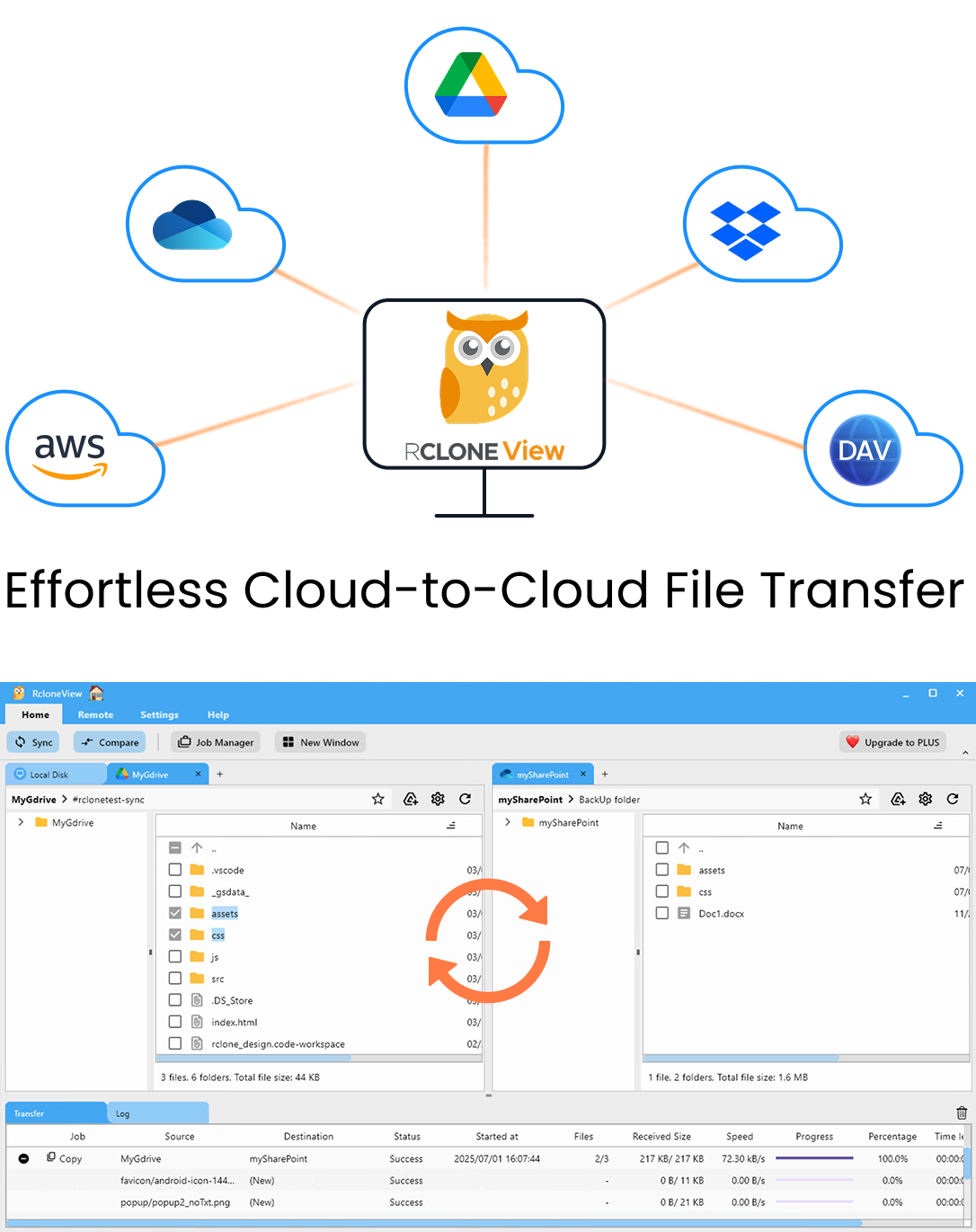
Manage & Sync All Clouds in One Place
RcloneView is a cross-platform GUI for rclone. Compare folders, transfer or sync files, and automate multi-cloud workflows with a clean, visual interface.
- One-click jobs: Copy · Sync · Compare
- Schedulers & history for reliable automation
- Works with Google Drive, OneDrive, Dropbox, S3, WebDAV, SFTP and more
Free core features. Plus automations available.
Provider Support
S3 Browser supports Amazon S3 and S3-compatible services (Wasabi, Backblaze B2 S3, MinIO, DigitalOcean Spaces, Cloudflare R2, etc.). It does not support Google Drive, OneDrive, Dropbox, SFTP, WebDAV, or any non-S3 provider.
RcloneView supports 70+ providers including all S3-compatible services, Google Drive, OneDrive, Dropbox, MEGA, Box, Backblaze B2 (native and S3), SFTP, WebDAV, FTP, Azure Blob, Google Cloud Storage, and many more. For S3-only workflows, both tools work well. For multi-cloud environments, RcloneView eliminates the need for separate tools per provider.
Platform Support
S3 Browser runs on Windows only.
RcloneView runs on Windows, macOS, and Linux. For teams with mixed operating systems or administrators who manage cloud storage from a Linux server, RcloneView provides cross-platform consistency.
Interface and Navigation
Both tools provide a file browser interface for navigating buckets and objects. S3 Browser uses a single-pane explorer with a tree view sidebar. RcloneView uses a two-pane explorer where you can open two different remotes (or two different buckets) side by side.
The two-pane layout is particularly useful for S3 workflows like comparing bucket contents, copying between buckets in different regions, or transferring files between S3 and Google Drive. RcloneView also includes a built-in terminal for running rclone commands directly when needed.
S3-Specific Features
S3 Browser provides deep S3 integration: bucket policy editor, CORS configuration, lifecycle rule management, server-side encryption settings, access control list editing, and pre-signed URL generation. These are valuable for S3 administrators who need to manage bucket configurations.
RcloneView focuses on file operations: browse, copy, sync, move, delete, compare, and mount. It does not expose bucket-level configuration settings like lifecycle rules or CORS. For S3 administration tasks, you would use the AWS console or CLI alongside RcloneView.
Sync and Scheduling
S3 Browser offers folder sync in its Pro version (paid). The free version supports manual file transfers only.
RcloneView provides sync, copy, and move operations with built-in job scheduling. Configure a recurring sync job with cron-style scheduling, bandwidth limits, and filter rules — all through the GUI. Job history tracks every run with transfer statistics.
Encryption
S3 Browser supports S3 server-side encryption (SSE-S3, SSE-KMS, SSE-C). Client-side encryption is not available.
RcloneView supports S3 server-side encryption and adds client-side encryption through rclone's crypt remote. With crypt, files are encrypted on your machine before upload — even the provider cannot read your data. This works with S3 and every other supported provider.
Mounting and Local Access
S3 Browser does not support mounting S3 buckets as local drives.
RcloneView can mount any S3 bucket (or any other remote) as a local drive letter on Windows or mount point on macOS/Linux. This enables applications that do not support S3 natively to access bucket contents as if they were local files.
Feature Comparison Table
| Feature | RcloneView | S3 Browser |
|---|---|---|
| Platform | Windows, macOS, Linux | Windows only |
| S3 and S3-compatible | Yes | Yes |
| Non-S3 providers | 70+ providers | No |
| Two-pane explorer | Yes | No (single pane) |
| Bucket policy editor | No | Yes |
| Lifecycle rules GUI | No | Yes |
| Built-in scheduling | Yes | Pro only |
| Mount as local drive | Yes | No |
| Client-side encryption | Yes (crypt) | No |
| Real-time monitoring | Yes | Basic |
| Free for personal use | Yes | Yes (limited) |
When to Choose Each Tool
Choose S3 Browser when:
- You work exclusively with S3 and S3-compatible providers on Windows.
- You need bucket-level administration features (policies, CORS, lifecycle rules).
- You want a lightweight tool specifically for S3 file browsing and management.
Choose RcloneView when:
- You manage data across S3 and other providers (Google Drive, OneDrive, SFTP, etc.).
- You need cross-platform support (macOS, Linux, or Windows).
- You want built-in scheduling, monitoring, and job history.
- You need to mount S3 buckets as local drives.
- You want client-side encryption with crypt remotes.
Getting Started with RcloneView
- Download RcloneView from rcloneview.com.
- Add your S3 or S3-compatible remote in the Remote Manager.
- Browse buckets alongside other cloud providers in the two-pane explorer.
- Set up sync jobs, mount buckets, or configure encrypted backups.
S3 Browser is a solid choice for Windows users who only need S3 file management with bucket administration features. RcloneView provides a broader solution with multi-cloud support, cross-platform compatibility, built-in scheduling, and encryption — making it the better choice for teams managing data beyond S3.
Related Guides:
Supported Cloud Providers