Use Backup Dir for Versioned Cloud Sync with RcloneView
Accidentally overwriting or deleting files during a sync is every cloud user's nightmare. RcloneView makes versioned syncs effortless with built-in support for
--backup-dir, ensuring you never lose a previous version again.
When you run a standard sync operation, files at the destination that differ from the source are overwritten, and files that no longer exist at the source are deleted. This is efficient, but it is also destructive. If a file was corrupted at the source, or if you accidentally deleted something you still needed, those changes propagate to the destination with no way back.
The --backup-dir flag solves this problem elegantly. Instead of permanently removing overwritten or deleted files, rclone moves them to a separate backup directory first. This gives you a complete safety net: every file that would have been lost is preserved in a location you control.
RcloneView lets you configure --backup-dir through its custom flags interface, so you get all the power of versioned syncs without memorizing command-line syntax. Combined with --suffix for date-stamped versions, you can build a lightweight file versioning system using nothing but your existing cloud storage.
Manage & Sync All Clouds in One Place
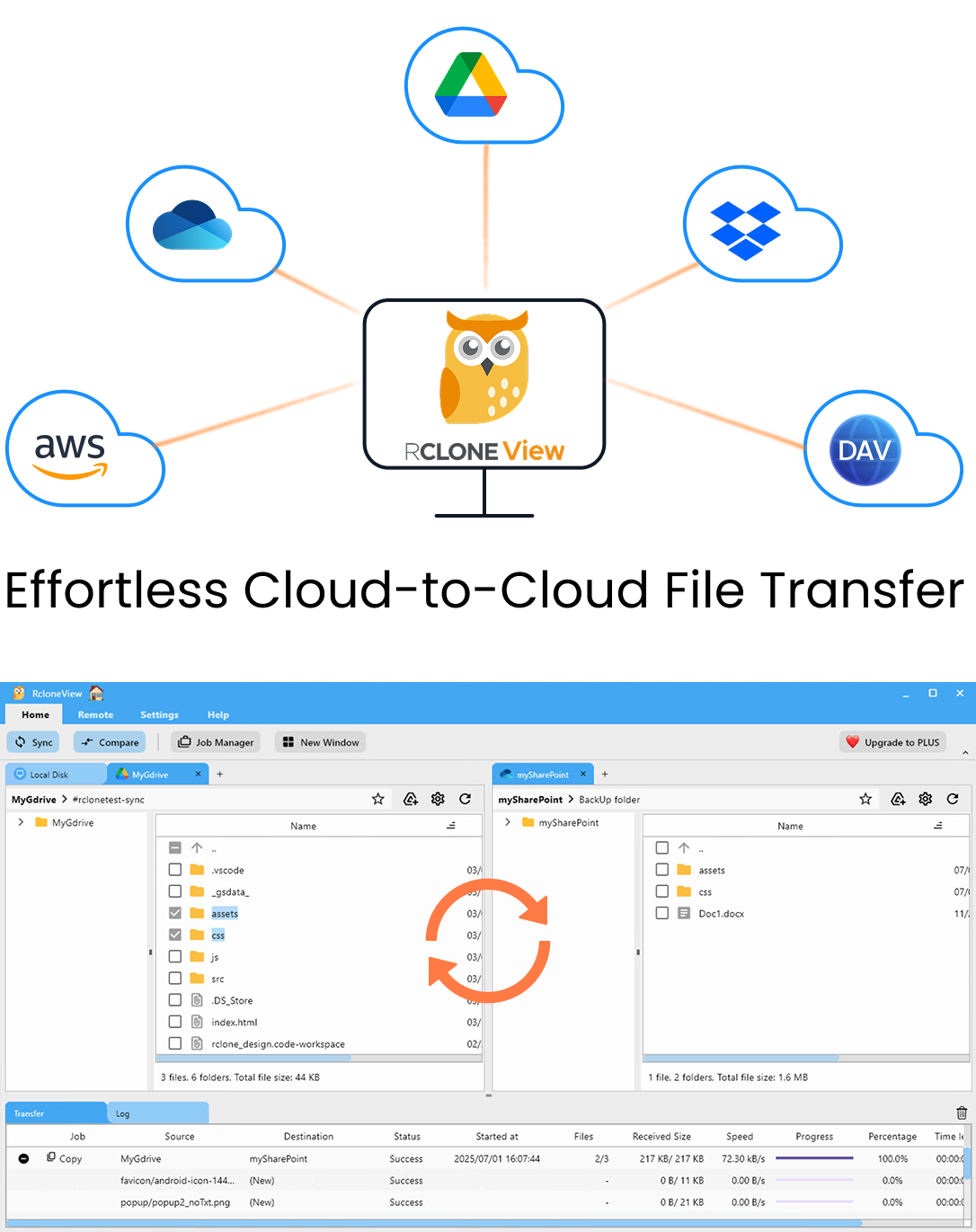
RcloneView is a cross-platform GUI for rclone. Compare folders, transfer or sync files, and automate multi-cloud workflows with a clean, visual interface.
- One-click jobs: Copy · Sync · Compare
- Schedulers & history for reliable automation
- Works with Google Drive, OneDrive, Dropbox, S3, WebDAV, SFTP and more
Free core features. Plus automations available.
What --backup-dir Actually Does
When a sync operation encounters a file at the destination that needs to be overwritten or deleted, --backup-dir intercepts that action. Instead of destroying the file, rclone moves it to the specified backup directory, preserving its relative path structure.
For example, if your sync overwrites documents/report.docx on the destination, the old version gets moved to backup/documents/report.docx. The directory hierarchy is maintained, making it easy to locate and restore specific files later.
This applies to two scenarios:
- Overwritten files: When a source file is newer or different, the old destination copy is moved to the backup directory before the new version replaces it.
- Deleted files: When a file exists at the destination but not at the source, it is moved to the backup directory instead of being permanently removed.
Why Versioned Syncs Are Essential
Standard sync operations assume you always want the destination to mirror the source exactly. That works well until something goes wrong. Consider these common scenarios:
- A file gets corrupted or infected with ransomware at the source, and the corruption propagates to your backup before you notice.
- You accidentally delete a folder, and the next scheduled sync removes it from the destination too.
- A colleague overwrites a shared document, and the previous version vanishes from both locations.
With --backup-dir, every one of these situations is recoverable. The previous versions sit safely in your backup directory, untouched by subsequent sync operations.
Configuring --backup-dir in RcloneView
RcloneView supports custom rclone flags in its job configuration. Here is how to set up a versioned sync:
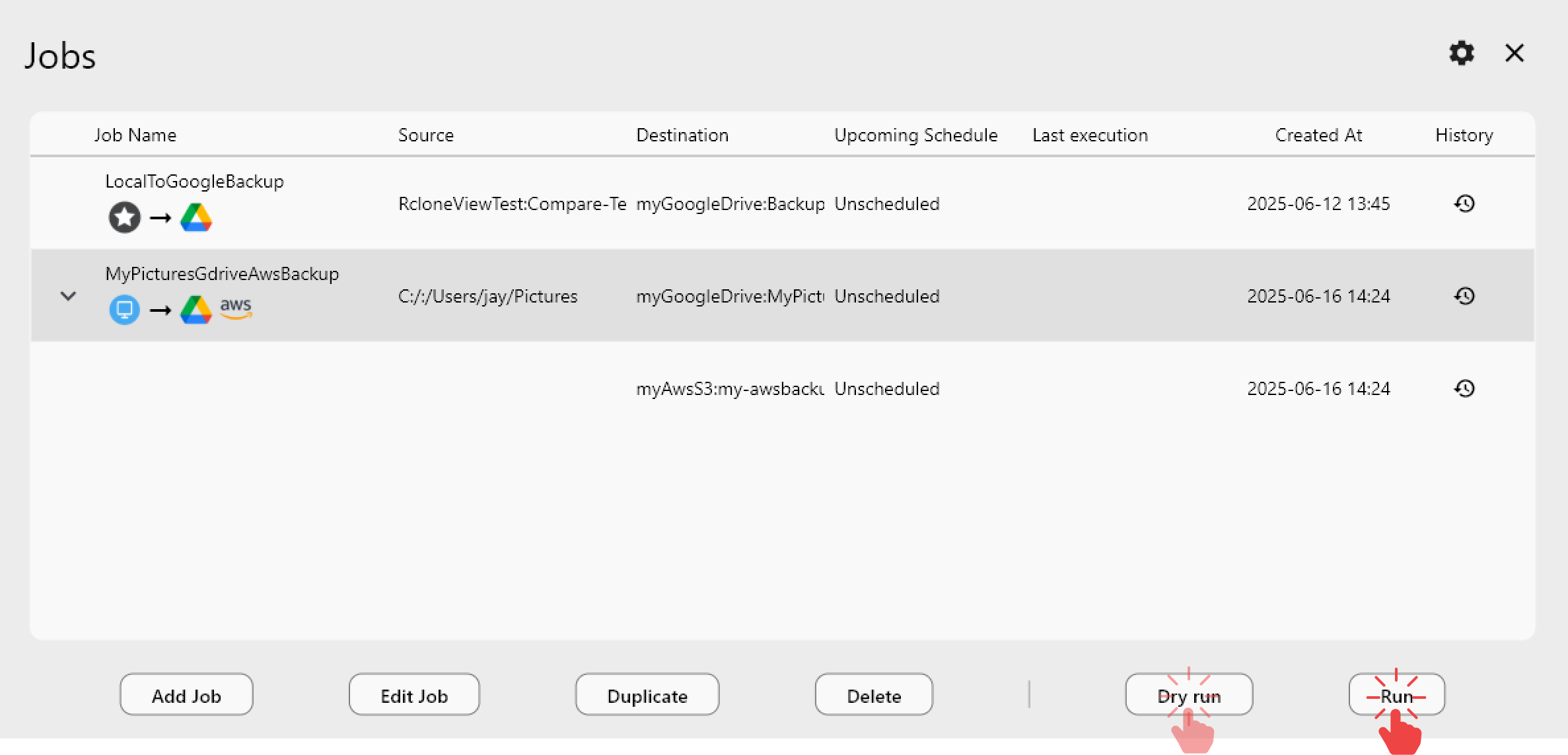
- Open the Job Manager and create a new sync job or edit an existing one.
- Set your source and destination remotes as usual.
- In the Custom Flags section, add:
--backup-dir remote:backup/2026-04-08 - Save and run the job.
The backup directory can be on the same remote as the destination or on an entirely different remote. Using a date-based path like backup/2026-04-08 keeps each day's displaced files organized in their own folder.
Combining --backup-dir with --suffix for Date-Stamped Versions
For even more granular versioning, combine --backup-dir with --suffix to append a timestamp to each backed-up file. This prevents filename collisions when the same file is modified and synced multiple times.
Add both flags in the custom flags section:
--backup-dir remote:backup --suffix .2026-04-08
With this configuration, if report.docx is overwritten, the old version is saved as backup/report.docx.2026-04-08. Run the sync again the next day with an updated suffix, and you accumulate a history of dated versions without any conflicts.
For automated jobs that run on a schedule, you can use dynamic suffixes tied to the execution date, ensuring each run creates uniquely named backups.
Practical Examples
Daily backup with version retention: Sync your Google Drive to Backblaze B2 nightly, with each day's displaced files stored in a dated backup folder. After 30 days, you can clean up old backup directories to manage storage costs.
Team project protection:
Sync a shared Dropbox folder to S3, using --backup-dir to capture any files that team members delete or overwrite. This acts as a lightweight audit trail without requiring premium versioning features from your cloud provider.
Migration safety net:
When migrating from one cloud to another, use --backup-dir during the initial sync to capture any destination files that would be overwritten. If the migration does not go as planned, you have a complete rollback point.
Recovery Workflow
Restoring files from your backup directory is straightforward in RcloneView:
- Open the Remote Explorer and navigate to your backup directory.
- Browse the directory structure to find the file you need. The original folder hierarchy is preserved.
- Use drag-and-drop or a copy operation to move the file back to its original location.
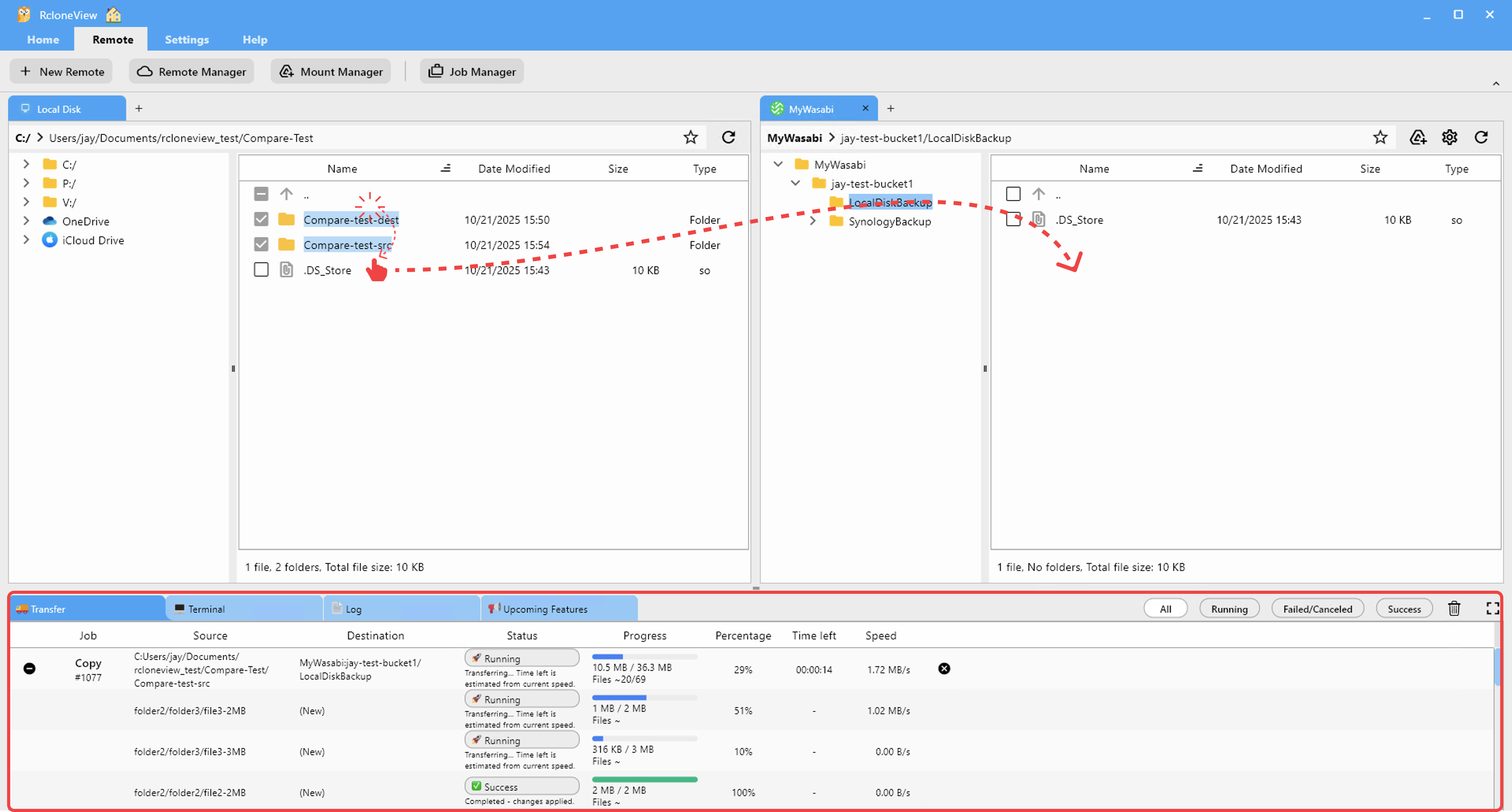
Because backup directories are just regular folders on your remote, you can also browse them, download files, or even sync them to another location for archival purposes.
Managing Backup Storage Over Time
Versioned backups accumulate over time, so it is important to have a retention strategy. Here are some approaches:
- Date-based folders: Use a dated backup directory path (e.g.,
backup/2026-04-08) and periodically delete folders older than your retention window. - Suffix-based cleanup: When using
--suffix, you can identify and remove files with old date suffixes. - Separate low-cost storage: Point your backup directory to an affordable object storage provider like Wasabi or Backblaze B2, where long-term retention costs are minimal.
RcloneView's Explorer makes it easy to browse backup directories and delete outdated versions when you are ready to reclaim space.
Best Practices for --backup-dir
- Always test your
--backup-dirconfiguration with a dry run first to confirm files are being routed to the correct location. - Keep the backup directory on the same remote as the destination when possible, since moves within the same remote are instant and do not consume bandwidth.
- Use consistent naming conventions for your backup paths so automated cleanup scripts can easily identify old versions.
- Combine
--backup-dirwith--backup-diron a different remote for critical data, giving you both a quick-recovery local backup and a geographically separate archive.
Getting Started
- Download RcloneView from rcloneview.com.
- Create a sync job with your source and destination remotes configured.
- Add
--backup-dir remote:backup/YYYY-MM-DDin the custom flags field to enable versioned syncs. - Run a dry run first to verify the configuration, then execute the job.
With --backup-dir configured, every sync operation becomes a safe, reversible process. You get the efficiency of one-way sync with the peace of mind that nothing is ever permanently lost.
Related Guides:
Supported Cloud Providers