Back Up Mega Files to OneDrive — Secure Cloud Redundancy with RcloneView
Protect your data by combining Mega’s encryption with OneDrive’s Microsoft 365 integration—all in a simple GUI workflow.
Bring your content closer to collaboration. Transfer files from Mega to Google Drive—visually, reliably, and without command-line hassles.
Mega offers strong encryption and generous free tiers, making it popular for personal storage. Google Drive, on the other hand, excels at collaboration—Docs, Sheets, Slides, Gmail, and Workspace integration.
Compare an object storage workhorse with a collaboration-first drive—and learn how to move files between them with a clean, point-and-click workflow.
Cloud storage isn’t one-size-fits-all. Backblaze B2 shines as affordable, S3-compatible object storage for backups and archives, while Dropbox excels at desktop-style sync, sharing, and collaboration. Many teams mix both: B2 for durable, low-cost storage and Dropbox for day-to-day work and external sharing. RcloneView brings these worlds together so you can preview, copy, and sync between them without touching the CLI.
Keep a second copy off-site without scripts or terminals. Back up your Synology NAS to Backblaze, Google Drive, Amazon S3, pCloud, Wasabi, and more—visually, reliably, and on a schedule.
A NAS is fantastic for fast, local access—family photos, creative projects, and team shares are only a LAN away. But on-prem only has risks: theft, fire, accidental deletion, or multi-drive failures. Adding an off-site cloud copy gives you:
Keep a local safety copy and take control of your data. Mirror your cloud drives to a Synology NAS with a clean, point-and-click workflow—no command line required.
Cloud storage is convenient for collaboration and access anywhere. But keeping a second, on-premises copy on a Synology NAS gives you versioned backups, LAN-speed restores, and independence from any single provider. With RcloneView, you can connect popular cloud services (e.g., Google Drive, OneDrive, and more supported by rclone) and your NAS, then preview, copy, and schedule jobs from one screen.
Streamline your cloud workflow — even if you're not a tech guru.
In today’s cloud-rich world, it's common to store files across multiple platforms. Maybe you started with OneDrive thanks to Microsoft's ecosystem, but now find yourself leaning more toward Google Drive for its collaboration features and familiarity with Google Workspace. Consolidating your files makes access easier, boosts productivity, and simplifies management for both individuals and organizations.
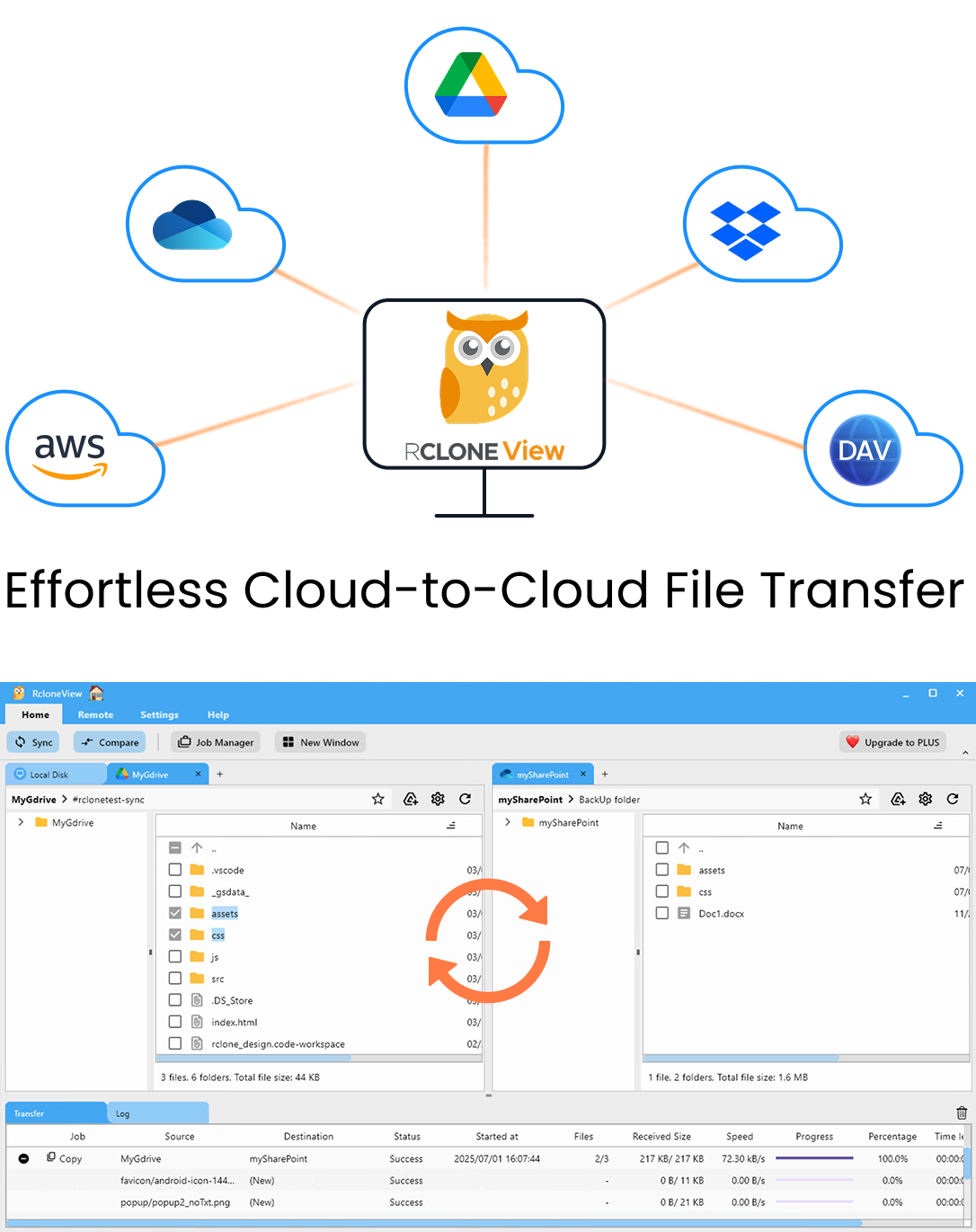
Imagine juggling multiple cloud drives—Google Drive here, Dropbox there, maybe even AWS S3 for backups. You want your files just there when and where you need them. But managing all those platforms separately can feel like herding cats.
Bring your files closer to where your team collaborates. Move content from pCloud to Google Drive in a clean, point-and-click workflow—no CLI required.
Many users start with pCloud for its straightforward apps and generous file handling, then shift day-to-day collaboration to Google Drive for Docs/Sheets/Slides and Workspace features. Consolidating your data helps reduce context-switching and unifies search, sharing, and access controls.
Publish and protect your media library by moving it from your hard drive to Gofile—all with clicks, not commands.
If your video edits, raw photos, and audio masters live only on a single drive, they’re one spill or disk error away from disappearing. Moving media to Gofile gives you cloud reach, easy sharing, and space relief on your workstation. With RcloneView, you get the power of rclone in a friendly GUI: connect, preview, copy, and schedule—no terminal needed.
Smoothly migrate, sync, and manage your files across Google Drive and OneDrive — without touching the command line.
In today’s multi-cloud reality, many people and organizations use Google Drive for collaboration while relying on OneDrive for seamless Office integration. This often creates a split workflow: documents in Google’s ecosystem, presentations and spreadsheets in Microsoft’s. Transferring files between these two platforms is essential to streamline work, avoid duplication, and consolidate storage.