AWS S3 vs Cloudflare R2: Object Storage Comparison for RcloneView Users
AWS S3 is the industry standard for object storage. Cloudflare R2 eliminates egress fees entirely. RcloneView connects to both — here is how to choose.
AWS S3 established the object storage category and remains the most widely adopted service with 11 nines of durability, comprehensive lifecycle management, and deep integration with the AWS ecosystem. Cloudflare R2 launched as a direct competitor with a radical pricing advantage: zero egress fees. For RcloneView users managing data across multiple providers, understanding the trade-offs between S3 and R2 helps optimize both cost and functionality.
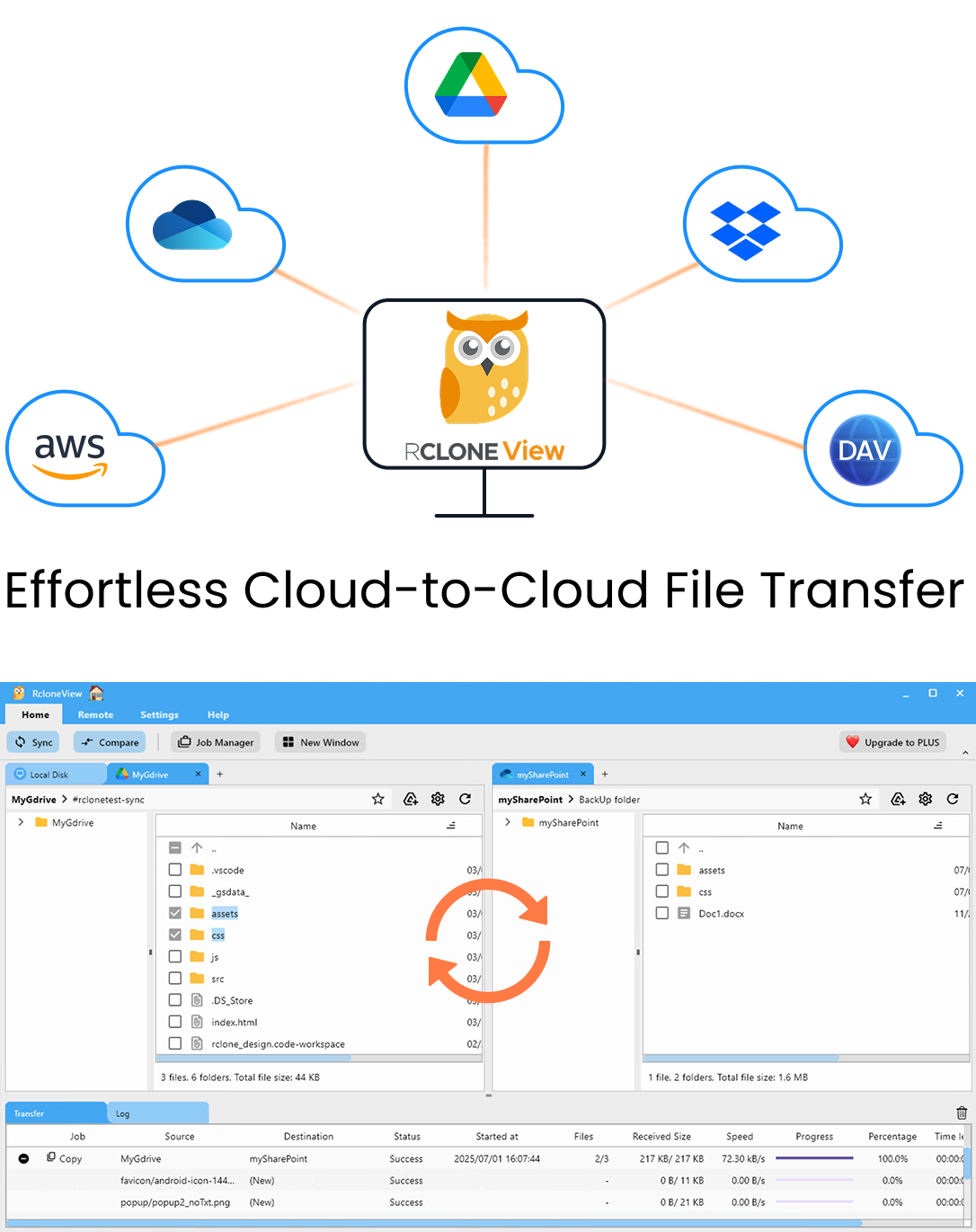
Manage & Sync All Clouds in One Place
RcloneView is a cross-platform GUI for rclone. Compare folders, transfer or sync files, and automate multi-cloud workflows with a clean, visual interface.
- One-click jobs: Copy · Sync · Compare
- Schedulers & history for reliable automation
- Works with Google Drive, OneDrive, Dropbox, S3, WebDAV, SFTP and more
Free core features. Plus automations available.
Pricing Comparison
Storage Costs
| Tier | AWS S3 | Cloudflare R2 |
|---|---|---|
| Standard | $0.023/GB/month | $0.015/GB/month |
| Infrequent Access | $0.0125/GB/month | Not available |
| Glacier Instant | $0.004/GB/month | Not available |
| Glacier Deep Archive | $0.00099/GB/month | Not available |
R2 is 35% cheaper than S3 Standard for active storage. However, S3's tiered storage classes (Infrequent Access, Glacier, Deep Archive) offer significantly lower prices for data that is rarely accessed. If your data has mixed access patterns, S3's lifecycle policies can automatically transition objects to cheaper tiers over time — a capability R2 does not offer.
Egress Costs
This is R2's headline advantage. AWS S3 charges $0.09/GB for data transferred out to the internet (with lower rates for higher volumes and free transfer to CloudFront). Cloudflare R2 charges $0.00 for egress — all data retrieval is free.
For a 10 TB monthly egress workload, the difference is stark: roughly $900/month on S3 vs. $0 on R2. For storage-heavy, low-egress workloads, the difference is smaller and S3's ecosystem advantages may outweigh the egress savings.
API Operations
| Operation | AWS S3 | Cloudflare R2 |
|---|---|---|
| PUT/POST (Class A) | $0.005/1,000 | $0.0045/1,000 (first 1M free) |
| GET (Class B) | $0.0004/1,000 | $0.00036/1,000 (first 10M free) |
| DELETE | Free | Free |
R2 offers generous free tiers for API operations and is slightly cheaper per operation beyond the free tier. For workloads with high API call volumes (millions of small object operations), the free tiers on R2 provide meaningful savings.
Feature Comparison
Storage Classes and Lifecycle
AWS S3 offers six storage classes (Standard, Intelligent-Tiering, Standard-IA, One Zone-IA, Glacier Instant Retrieval, Glacier Flexible Retrieval, Glacier Deep Archive) with lifecycle policies that automatically transition objects based on age or access patterns.
Cloudflare R2 offers a single storage class with an Infrequent Access tier. There are no Glacier-equivalent cold storage options and limited lifecycle management.
For archival workloads, S3's Glacier Deep Archive at $0.00099/GB/month is unmatched.
Durability and Availability
Both services provide high durability. AWS S3 quotes 99.999999999% (11 nines) durability. Cloudflare does not publish a specific durability number for R2 but states it is designed for high durability across multiple availability zones.
S3 Standard provides 99.99% availability. R2 does not publish a specific SLA but benefits from Cloudflare's global network.
Ecosystem Integration
AWS S3 integrates with the entire AWS ecosystem — Lambda, CloudFront, Athena, EMR, SageMaker, CloudTrail, and hundreds of other services. IAM policies, bucket policies, and VPC endpoints provide fine-grained access control.
Cloudflare R2 integrates with Cloudflare Workers (edge compute), Cloudflare CDN, and the Cloudflare dashboard. The integration is tighter and simpler but narrower in scope.
S3 API Compatibility
Both services support the S3 API. R2 implements the most commonly used S3 operations (GET, PUT, DELETE, multipart upload, list objects) but does not support every S3 feature — notably, S3 Select, S3 Object Lambda, and some advanced bucket configurations are not available on R2.
RcloneView connects to both using the same S3-compatible remote type, so switching between them in RcloneView is a matter of changing the endpoint and credentials.
Using Both with RcloneView
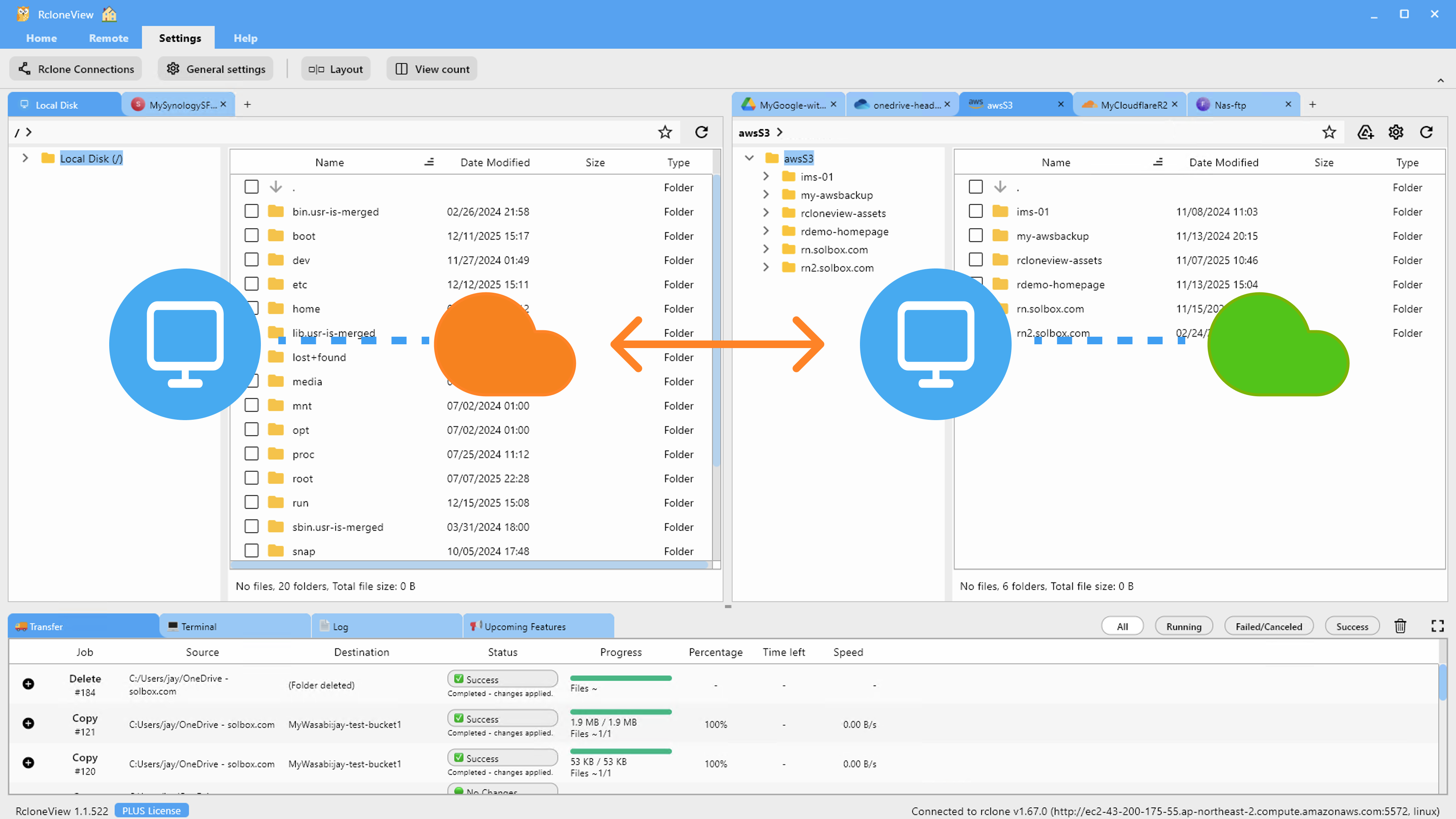
RcloneView's multi-cloud approach means you do not have to choose one or the other. A common strategy is to use S3 for archival data (leveraging Glacier tiers) and R2 for frequently accessed data (eliminating egress fees). RcloneView can sync, copy, or migrate between them with a few clicks in the two-pane explorer.
Set up both as S3-compatible remotes in the Remote Manager, and RcloneView handles the rest — compare bucket contents, run migrations, or schedule ongoing replication jobs.
When to Choose Each Provider
Choose AWS S3 when:
- You need lifecycle policies and Glacier cold storage tiers.
- Your workload integrates with other AWS services.
- You require advanced features like S3 Select, Object Lambda, or Inventory.
- Data egress is minimal relative to storage volume.
- You need the published 11 nines durability SLA.
Choose Cloudflare R2 when:
- Data egress is a significant portion of your costs.
- You serve content through Cloudflare's CDN network.
- Your application uses Cloudflare Workers for edge compute.
- You want simple, predictable pricing without egress surprises.
- Your data does not require cold storage tiering.
Getting Started
- Download RcloneView from rcloneview.com.
- Add AWS S3 and Cloudflare R2 as S3-compatible remotes in the Remote Manager.
- Browse both side by side in the two-pane explorer.
- Migrate, sync, or replicate data between them based on your cost and access requirements.
AWS S3 remains the gold standard for object storage with its ecosystem depth and archival tiers. Cloudflare R2 disrupts the pricing model by eliminating egress fees. RcloneView lets you leverage both — or switch between them — without vendor lock-in.
Related Guides:
Supported Cloud Providers