Install and Use RcloneView on Manjaro Linux for Cloud Sync
Manjaro takes the rolling-release power of Arch Linux and wraps it in a desktop-friendly package. Adding RcloneView gives you a visual multi-cloud file manager that fits naturally into Manjaro's philosophy of making powerful tools accessible.
Manjaro Linux has grown into one of the most popular Arch-based distributions, offering the rolling-release model and access to the AUR (Arch User Repository) while providing a more approachable installation and configuration experience. Whether you run Manjaro with XFCE, KDE Plasma, or GNOME, you get access to the latest software packages and a community that values choice and control. RcloneView complements this by giving Manjaro users a graphical interface for managing files across 70+ cloud storage providers — Google Drive, OneDrive, Dropbox, AWS S3, Backblaze B2, Wasabi, and many more. This guide walks through installation, cloud remote setup, file synchronization, drive mounting, and job scheduling on Manjaro.
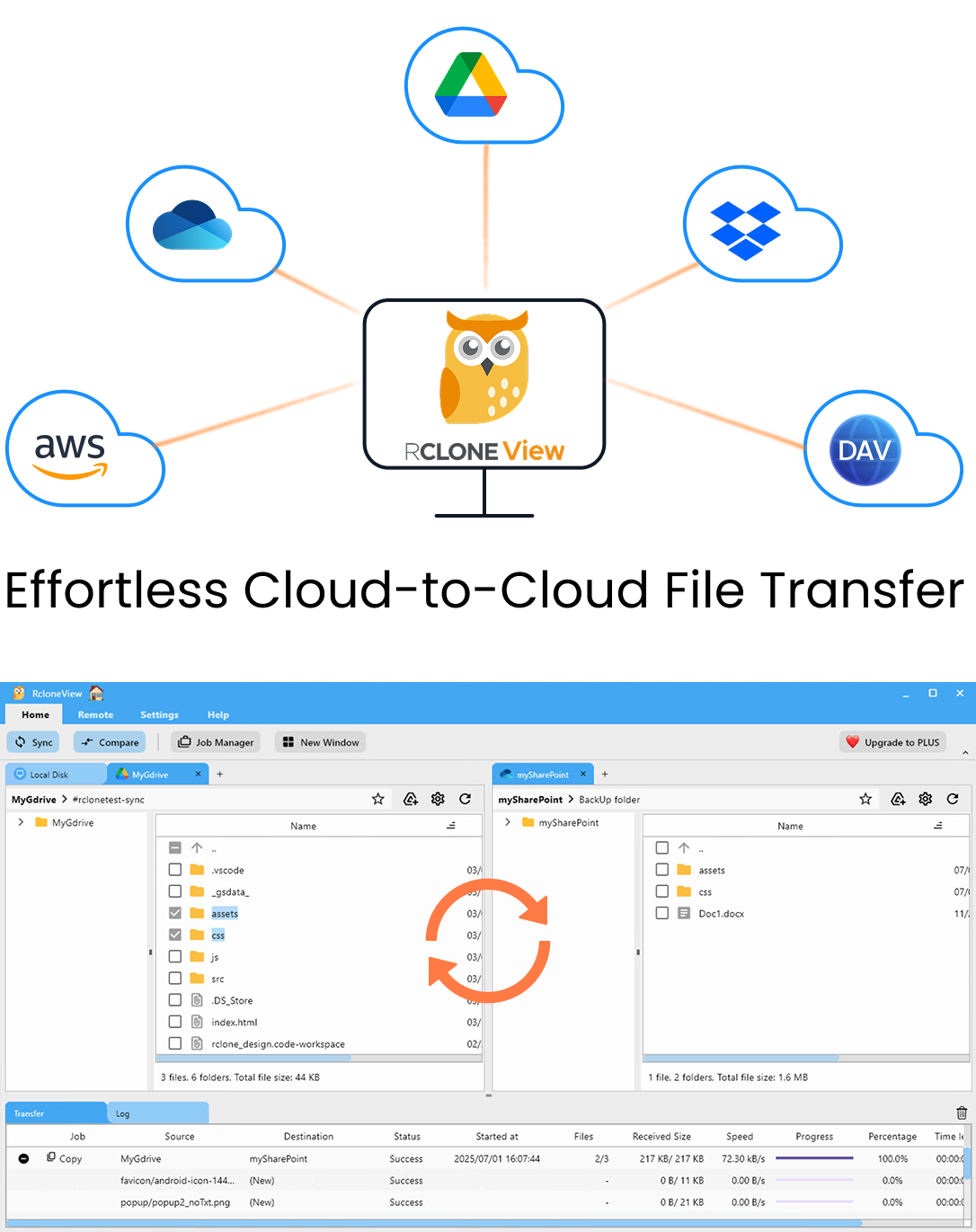
Manage & Sync All Clouds in One Place
RcloneView is a cross-platform GUI for rclone. Compare folders, transfer or sync files, and automate multi-cloud workflows with a clean, visual interface.
- One-click jobs: Copy · Sync · Compare
- Schedulers & history for reliable automation
- Works with Google Drive, OneDrive, Dropbox, S3, WebDAV, SFTP and more
Free core features. Plus automations available.
Why Manjaro for Cloud File Management
Manjaro offers several advantages as a platform for running RcloneView:
- Rolling releases — you always have access to the latest versions of rclone and system libraries without waiting for a distribution upgrade cycle.
- AUR access — the Arch User Repository provides community-maintained packages that are not available in the official repositories, expanding your options for installation.
- Hardware detection — Manjaro's mhwd tool automatically configures drivers, which matters for GPU-accelerated desktop environments where a smooth GUI experience depends on proper driver setup.
- Multiple desktop environments — whether you prefer KDE Plasma, XFCE, GNOME, or a tiling window manager, RcloneView runs on all of them through standard GTK/Qt compatibility.
- Active community — Manjaro's forums and wiki provide troubleshooting resources specific to the distribution's configuration quirks.
Prerequisites
Before installing RcloneView on Manjaro, ensure you have:
- Manjaro Linux (any edition — XFCE, KDE, GNOME, or community editions)
- A working internet connection
- At least 512 MB of free disk space
- An account with one or more cloud storage providers (Google Drive, OneDrive, S3, etc.)
- Basic familiarity with the terminal (though most operations will happen in the GUI)
Update your system first to ensure all packages are current:
sudo pacman -Syu
Or using Manjaro's graphical package manager, pamac:
pamac update
Installing RcloneView on Manjaro
Manjaro gives you several paths to install RcloneView. Choose the one that best fits your workflow.
Option 1: AppImage (Recommended for Most Users)
The AppImage is the simplest installation method. It bundles everything RcloneView needs into a single executable file — no dependency management required.
- Download the latest RcloneView AppImage from rcloneview.com.
- Make it executable:
chmod +x RcloneView-*.AppImage
- Run it:
./RcloneView-*.AppImage
To integrate the AppImage into your application menu, use a tool like AppImageLauncher, which is available in the Manjaro repositories:
sudo pacman -S appimagelauncher
Once installed, double-clicking the AppImage will prompt you to integrate it into your desktop environment.
Option 2: Install via pamac (AUR)
Manjaro's pamac package manager can install AUR packages directly. First, ensure AUR support is enabled in pamac:
- Open Add/Remove Software (pamac GUI).
- Go to Preferences > Third Party and enable AUR support.
- Search for
rcloneviewand install.
Or from the terminal:
pamac build rcloneview
pamac handles dependency resolution automatically, pulling in any required libraries.
Option 3: Install rclone Separately and Use the AppImage
If you want the latest rclone version managed through pacman while using the AppImage for the GUI:
sudo pacman -S rclone fuse3
Then download and run the RcloneView AppImage. RcloneView will detect the system-installed rclone and use it.
Verifying the Installation
After installation, launch RcloneView from your application menu or terminal. You should see the main window with the remote explorer and job management panels. If you installed rclone separately, verify it is detected:
rclone version
Adding Cloud Remotes
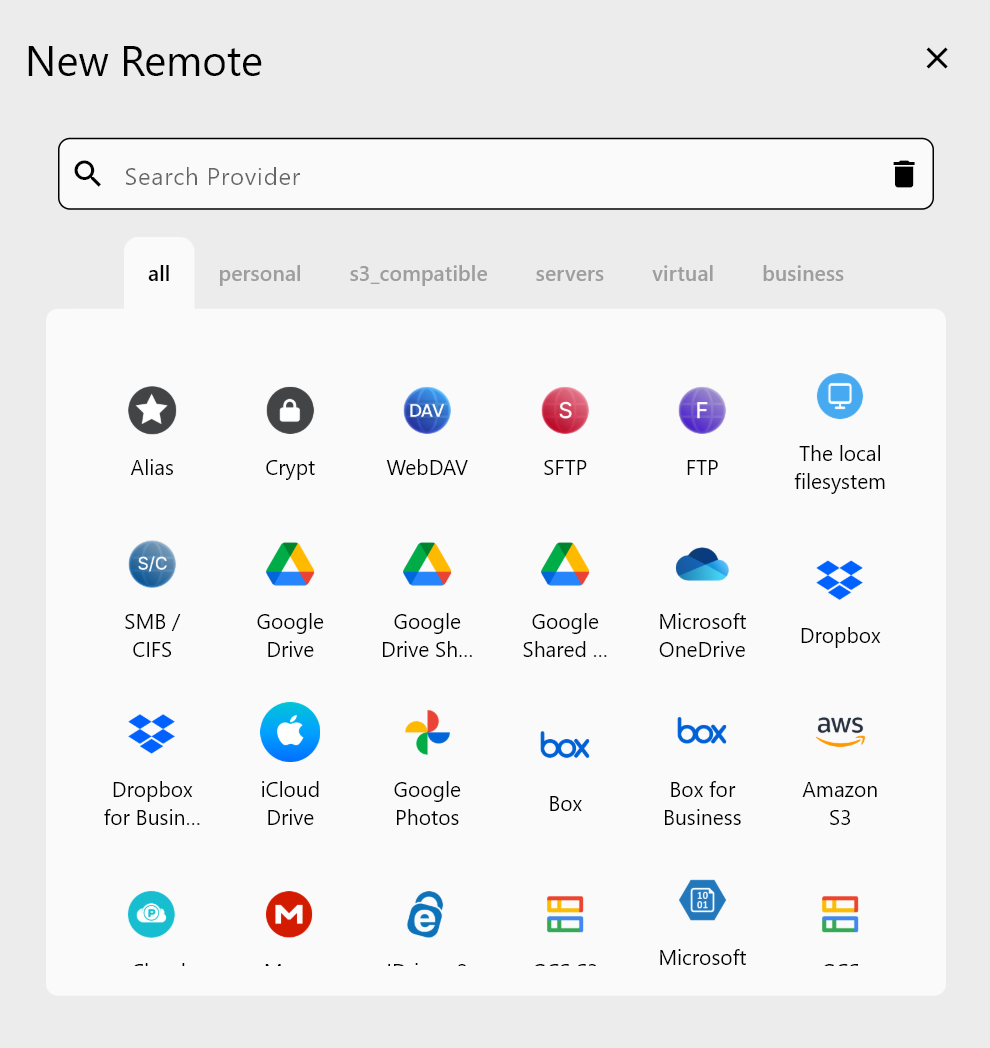
With RcloneView running, the first step is connecting your cloud storage accounts. RcloneView provides a guided setup for each provider.
Google Drive
- Click New Remote in the RcloneView interface.
- Select Google Drive from the provider list.
- Follow the OAuth authentication flow — a browser window will open for you to log in and grant access.
- Choose your access scope (full drive access, file-level access, or read-only).
- Save the remote.
OneDrive
- Click New Remote and select Microsoft OneDrive.
- Authenticate through the Microsoft OAuth flow in your browser.
- Select between personal OneDrive, OneDrive for Business, or SharePoint.
- Save the remote.
S3-Compatible Storage (AWS, Wasabi, Backblaze B2, MinIO)
- Click New Remote and select your S3-compatible provider.
- Enter your Access Key ID and Secret Access Key.
- Specify the region and endpoint (for non-AWS providers like Wasabi or MinIO, the endpoint URL is required).
- Save the remote.
You can add as many remotes as you need. All configured remotes appear in the sidebar for quick access.
Browsing and Syncing Files
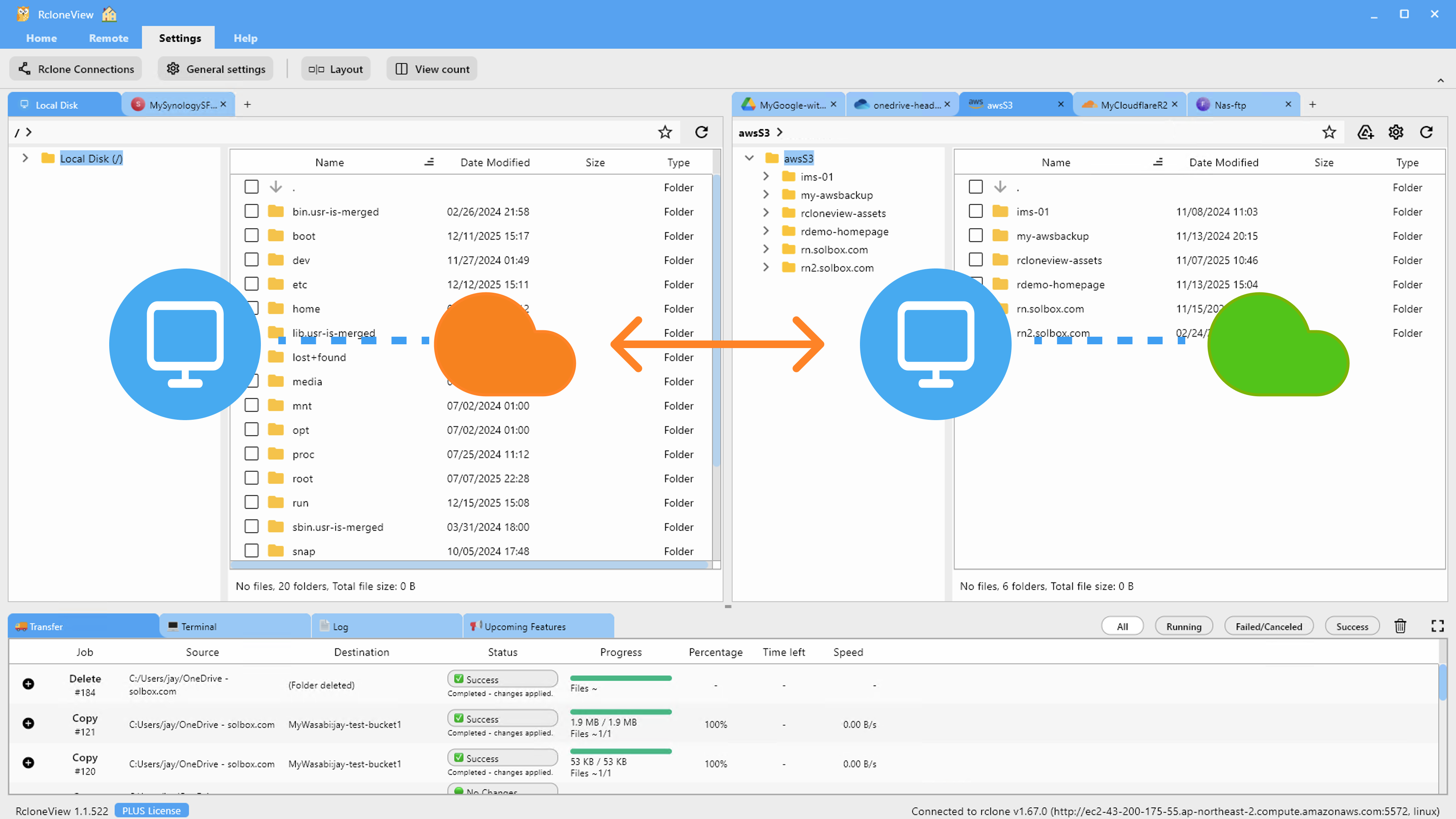
Once your remotes are configured, RcloneView's two-pane explorer lets you browse local and cloud files side by side. You can navigate folder structures, preview file details, and initiate transfers with drag-and-drop or toolbar buttons.
Copying Files
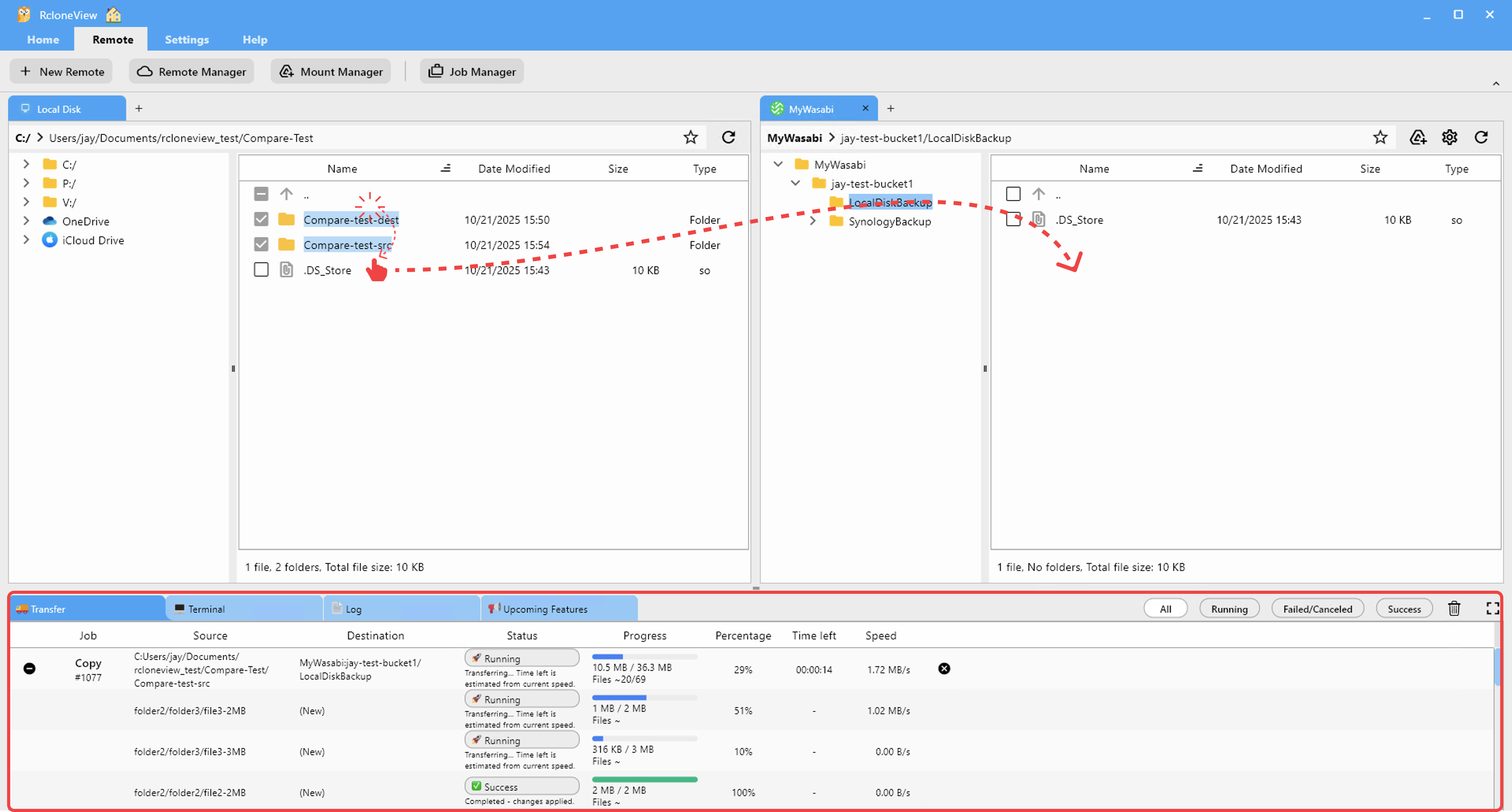
Select files or folders in one pane and copy them to the other pane's location. This works for:
- Local to cloud — upload files from your Manjaro filesystem to any connected cloud remote.
- Cloud to local — download files from cloud storage to your local disk.
- Cloud to cloud — transfer files directly between two cloud providers without downloading to your local machine first.
Syncing Folders
For ongoing synchronization, create a sync job that keeps two locations in sync:
- Open the source folder in the left pane and the destination in the right pane.
- Click Sync and configure the sync direction (one-way or mirror).
- Review the comparison to see which files will be added, updated, or deleted.
- Execute the sync.
Mounting Cloud Storage as a Local Drive
RcloneView can mount any cloud remote as a local filesystem directory on Manjaro. This lets you access cloud files through your file manager (Thunar, Dolphin, Nautilus) or any application as if they were on a local drive.
Setting Up a Mount
- Ensure FUSE is installed:
sudo pacman -S fuse3
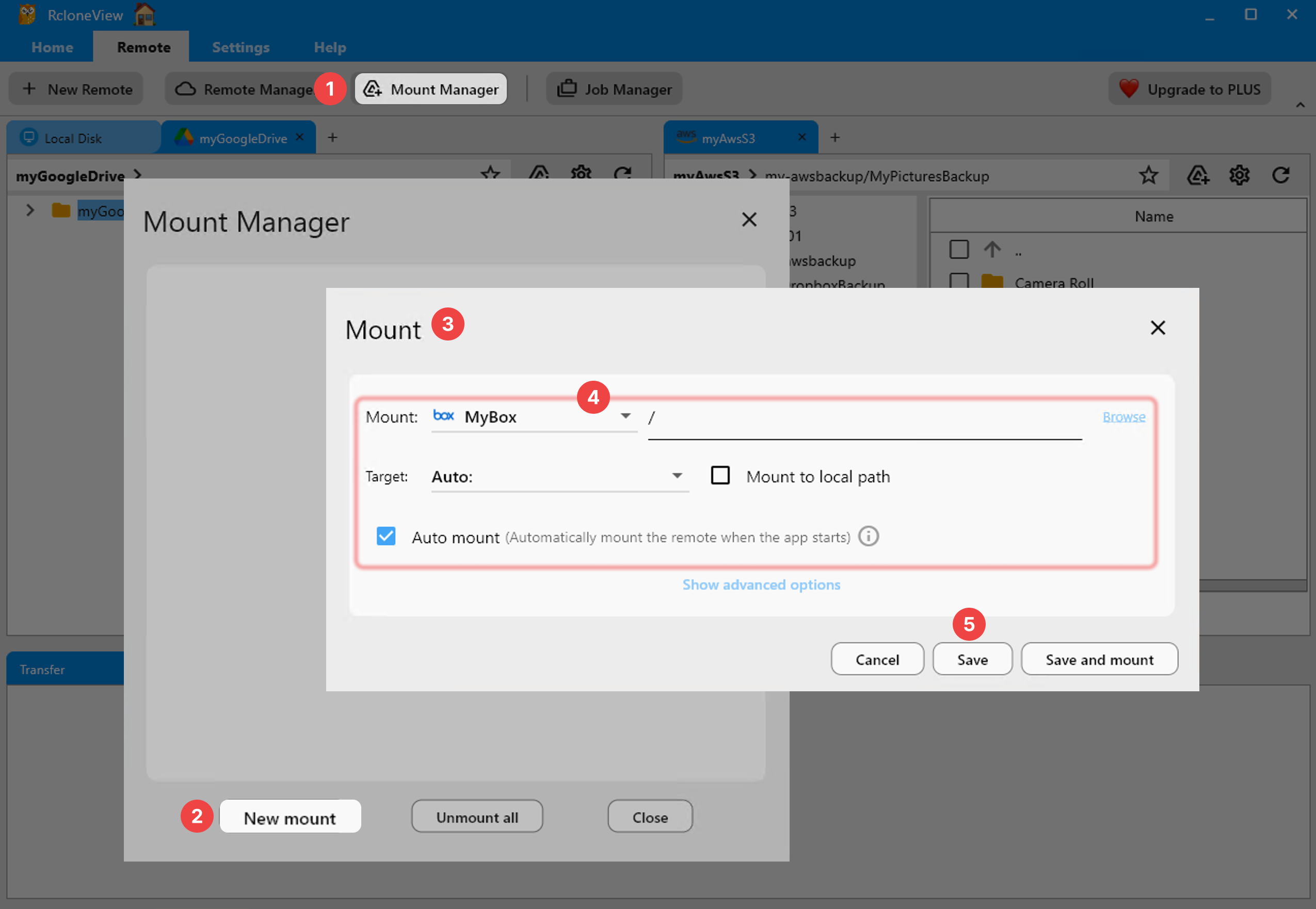
- In RcloneView, right-click a remote or navigate to the Mount Manager.
- Choose a local mount point (e.g.,
~/CloudDrive/GoogleDrive). - Configure mount options — cache settings, read-only or read-write, VFS cache mode.
- Click Mount.
The mounted drive appears in your file manager and is accessible to all applications. For example, you could point a media player at a mounted Google Drive folder or open CAD files directly from a mounted S3 bucket.
Mount Performance Tips on Manjaro
- Use VFS cache mode "full" for the best performance with applications that make random reads (document editors, media players).
- Set a cache directory on fast storage — if you have an NVMe SSD, point the VFS cache there for faster access.
- Increase the directory cache time for remotes with large folder structures to reduce API calls.
Scheduling Automated Sync Jobs
For ongoing backup and synchronization, RcloneView's job scheduler lets you define recurring sync operations that run automatically.
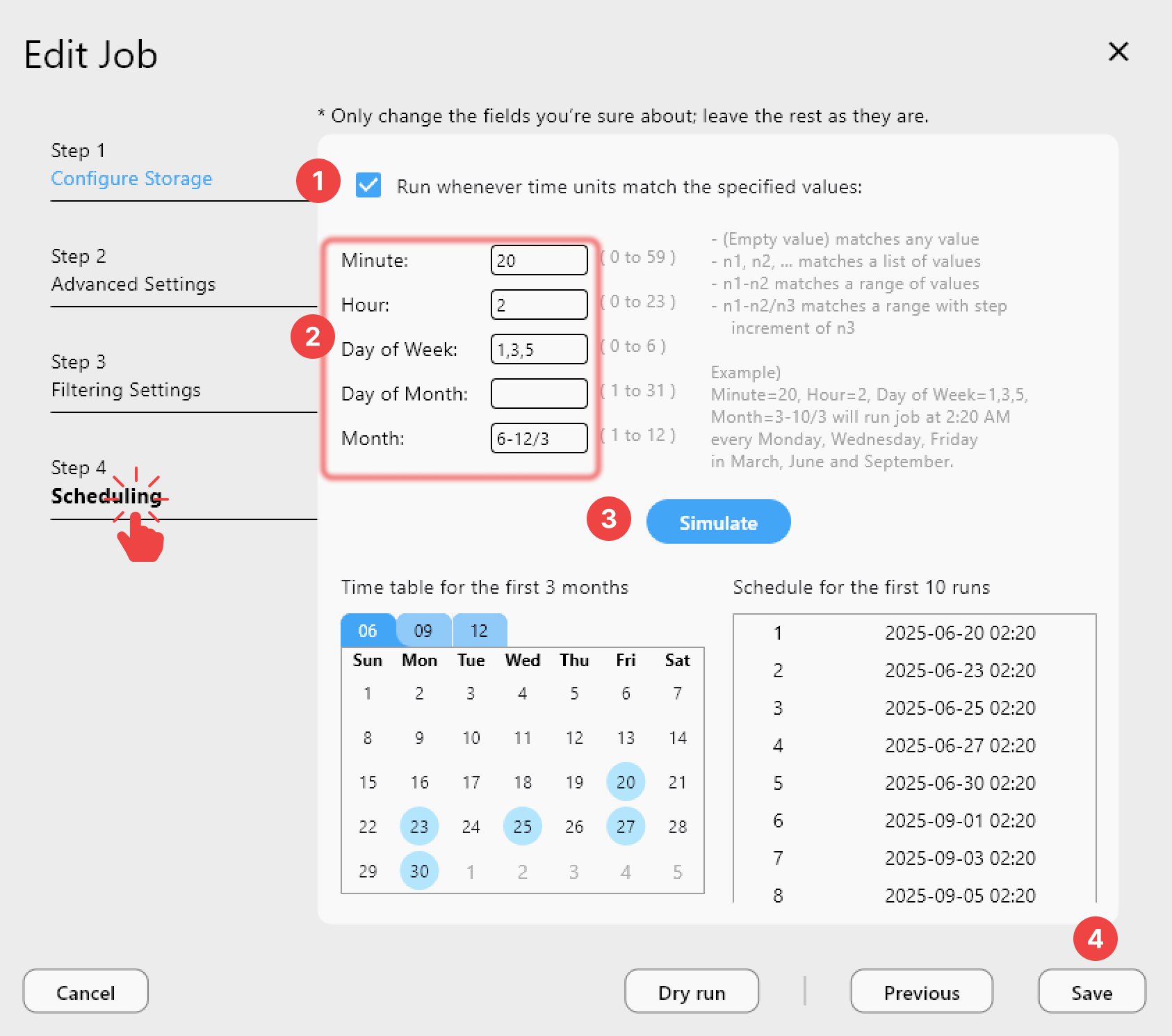
- Create a sync job by selecting source and destination remotes and folders.
- Open the job scheduler and set the frequency — hourly, daily, weekly, or a custom cron expression.
- Enable the schedule and let RcloneView handle the rest.
Common scheduling patterns for Manjaro users:
- Daily backup of ~/Documents to Google Drive — runs every evening to keep your documents mirrored in the cloud.
- Weekly sync of a project folder to S3 — keeps an off-site backup of large project files.
- Hourly sync of a shared team folder across multiple cloud providers for redundancy.
Troubleshooting Manjaro-Specific Issues
FUSE Permissions
If mounting fails with a permission error, ensure your user is in the fuse group:
sudo usermod -aG fuse $USER
Log out and back in for the group change to take effect.
Kernel Module Loading
On some Manjaro installations, the FUSE kernel module may not load automatically. Load it manually:
sudo modprobe fuse
To make this permanent, add fuse to /etc/modules-load.d/fuse.conf.
AppImage Font Rendering
If fonts look off in the AppImage version, install the necessary font packages:
sudo pacman -S noto-fonts ttf-liberation
OAuth Browser Authentication
If the OAuth browser window does not open automatically during remote setup, check that xdg-open is configured correctly:
xdg-settings get default-web-browser
If no default browser is set, configure one through your desktop environment's settings.
Getting Started
- Update Manjaro — run
sudo pacman -Syuto ensure your system is current. - Install RcloneView — use the AppImage for simplicity or pamac for AUR integration.
- Add your cloud remotes — connect Google Drive, OneDrive, S3, or any other provider.
- Browse, copy, and sync files using the two-pane explorer.
- Mount cloud storage as a local drive for seamless access from any application.
- Schedule automated backups to keep your data protected without manual effort.
Manjaro gives you a powerful, always-current Linux desktop. RcloneView gives you a powerful, always-current cloud file manager. Together, they cover the full spectrum from local files to multi-cloud storage without requiring a single command-line incantation.
Related Guides:
- Add Remote Storage (Google Drive Example)
- Mount Cloud Storage as a Local Drive
- Job Scheduling and Execution
Supported Cloud Providers