Rclone Filter Rules Explained: Include and Exclude Patterns for Smarter Syncs
Syncing everything is wasteful. Syncing the wrong things is dangerous. Rclone's filter rules let you precisely control what gets transferred — but the syntax can be confusing. This guide breaks it all down with practical examples.
When you sync or copy files between clouds, you rarely want everything. Maybe you need only .pdf files, or everything except .tmp files, or files modified in the last 7 days, or files under 100 MB. Rclone's filter system handles all of this — and RcloneView lets you configure these filters visually in your job settings.
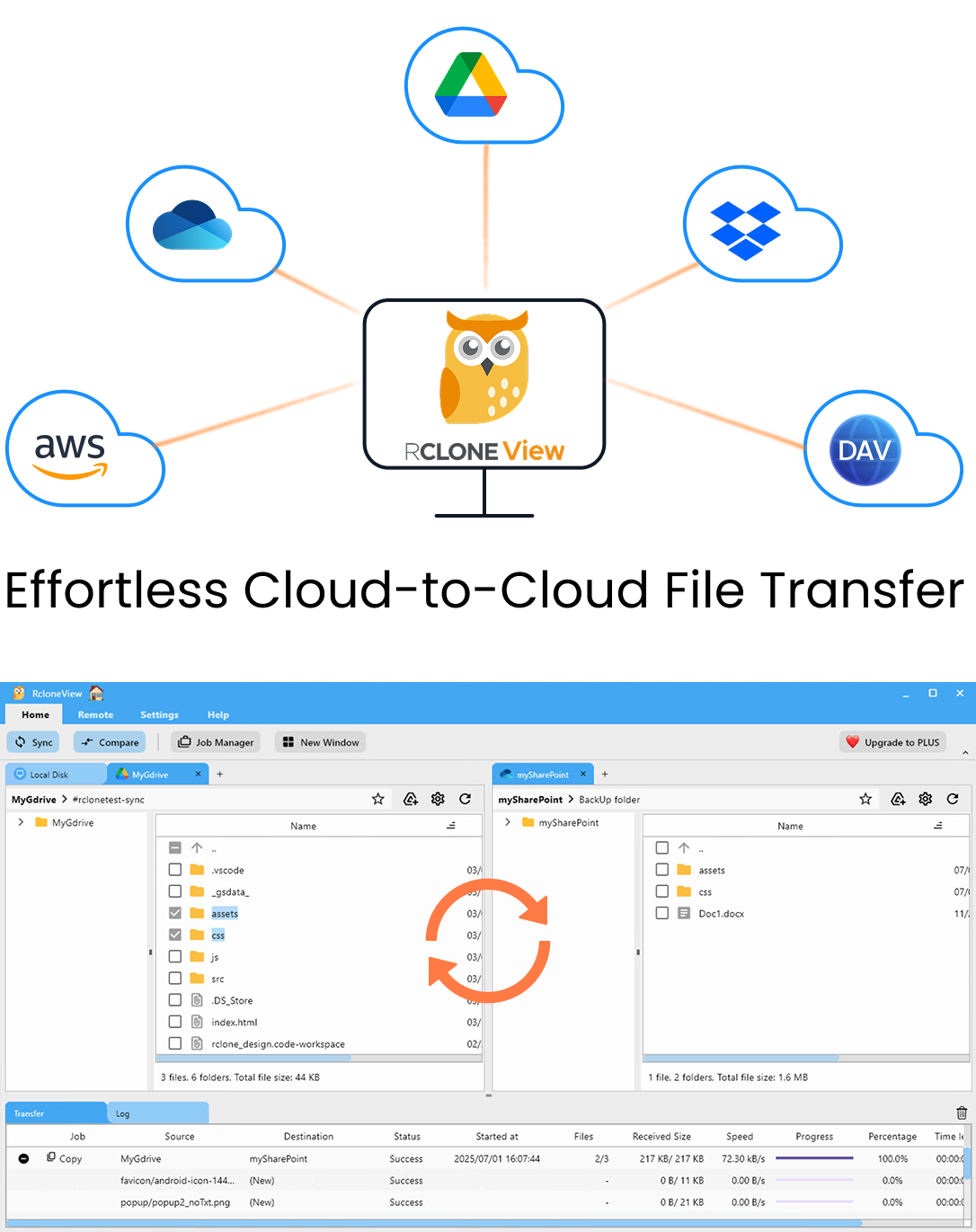
Manage & Sync All Clouds in One Place
RcloneView is a cross-platform GUI for rclone. Compare folders, transfer or sync files, and automate multi-cloud workflows with a clean, visual interface.
- One-click jobs: Copy · Sync · Compare
- Schedulers & history for reliable automation
- Works with Google Drive, OneDrive, Dropbox, S3, WebDAV, SFTP and more
Free core features. Plus automations available.
How Rclone Filters Work
Rclone processes filter rules in order, top to bottom. For each file, it checks the rules one by one:
- If a rule matches, the file is included or excluded (depending on the rule).
- If no rule matches, the file is included by default.
This "first match wins" behavior is critical to understand. Order matters.
Basic Patterns
Exclude specific files or folders
--exclude "*.tmp"
--exclude "node_modules/**"
--exclude ".DS_Store"
These patterns exclude:
- All
.tmpfiles anywhere in the tree. - The entire
node_modulesfolder and its contents. - All
.DS_Storefiles (macOS metadata).
Include specific files only
--include "*.pdf"
--include "*.docx"
When you use --include, rclone automatically excludes everything else. So --include "*.pdf" means "only sync PDFs, nothing else."
Combine include and exclude
--include "*.jpg"
--include "*.png"
--exclude "*"
This explicitly includes only JPG and PNG files. The --exclude "*" at the end catches everything else.
The --filter Flag
The --filter flag gives you both include and exclude in one rule:
--filter "+ *.pdf"
--filter "+ *.docx"
--filter "- *"
The + prefix means include, - means exclude. This is equivalent to separate --include and --exclude flags but more compact.
Filter-From File
For complex rule sets, put your filters in a file:
--filter-from /path/to/filters.txt
filters.txt:
# Include documents
+ *.pdf
+ *.docx
+ *.xlsx

# Include images
+ *.jpg
+ *.png

# Exclude everything else
- *
Lines starting with # are comments. This is the recommended approach for any sync job with more than 2-3 rules.
Directory Filters
Exclude a specific directory
--exclude "backup/**"
The ** means "this directory and everything inside it."
Include only a specific directory
--include "/projects/**"
--exclude "*"
This syncs only the projects folder at the root level.
Exclude directories by pattern
--exclude ".git/**"
--exclude "__pycache__/**"
--exclude "node_modules/**"
Common for developers syncing code repositories — skip version control and dependency folders.
Size Filters
Minimum file size
--min-size 1M
Skip files smaller than 1 MB. Useful for ignoring thumbnails or tiny cache files.
Maximum file size
--max-size 100M
Skip files larger than 100 MB. Useful when you want documents but not video files.
Size units
korK— KilobytesM— MegabytesG— Gigabytes
Example: --min-size 500k --max-size 2G syncs files between 500 KB and 2 GB.
Age Filters
Only recent files
--max-age 7d
Sync only files modified in the last 7 days. Ideal for incremental backups of active projects.
Only older files
--min-age 30d
Sync only files that haven't changed in 30 days. Useful for archiving stale data.
Age units
ms— Millisecondss— Secondsm— Minutesh— Hoursd— Daysw— WeeksM— Monthsy— Years
Practical Examples
Example 1: Backup only documents
Sync PDFs, Word docs, and spreadsheets from Google Drive to Backblaze B2:
--include "*.pdf"
--include "*.docx"
--include "*.xlsx"
--include "*.pptx"
--exclude "*"
Example 2: Skip large video files
Sync everything except video files over 500 MB:
--exclude "*.mp4"
--exclude "*.mov"
--exclude "*.avi"
--exclude "*.mkv"
Or use size filtering: --max-size 500M
Example 3: Developer project sync
Sync a code project without dependencies and build artifacts:
--exclude "node_modules/**"
--exclude ".git/**"
--exclude "__pycache__/**"
--exclude "dist/**"
--exclude "build/**"
--exclude "*.pyc"
Example 4: Archive files older than 90 days
Move old files from Google Drive to S3 Glacier:
--min-age 90d
Example 5: Photo backup (skip RAW, keep JPEG)
--include "*.jpg"
--include "*.jpeg"
--include "*.png"
--include "*.heic"
--exclude "*.cr2"
--exclude "*.nef"
--exclude "*.arw"
--exclude "*"
Using Filters in RcloneView
When creating a sync or copy job in RcloneView, you can add filter rules in the job configuration. These are passed directly to rclone:
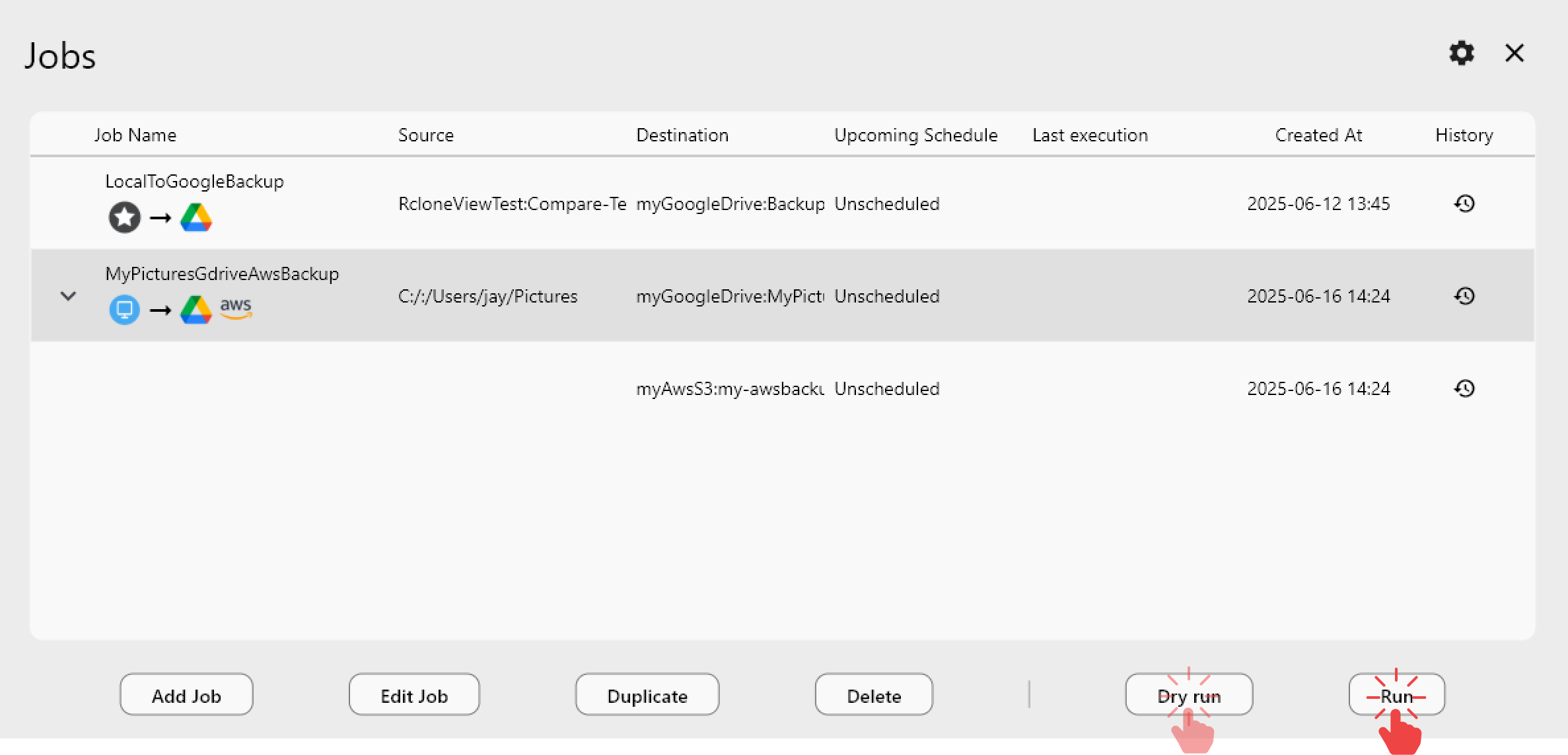
Dry run to verify
Always use dry run first when testing new filter rules. This shows you exactly which files would be included or excluded without actually transferring anything.
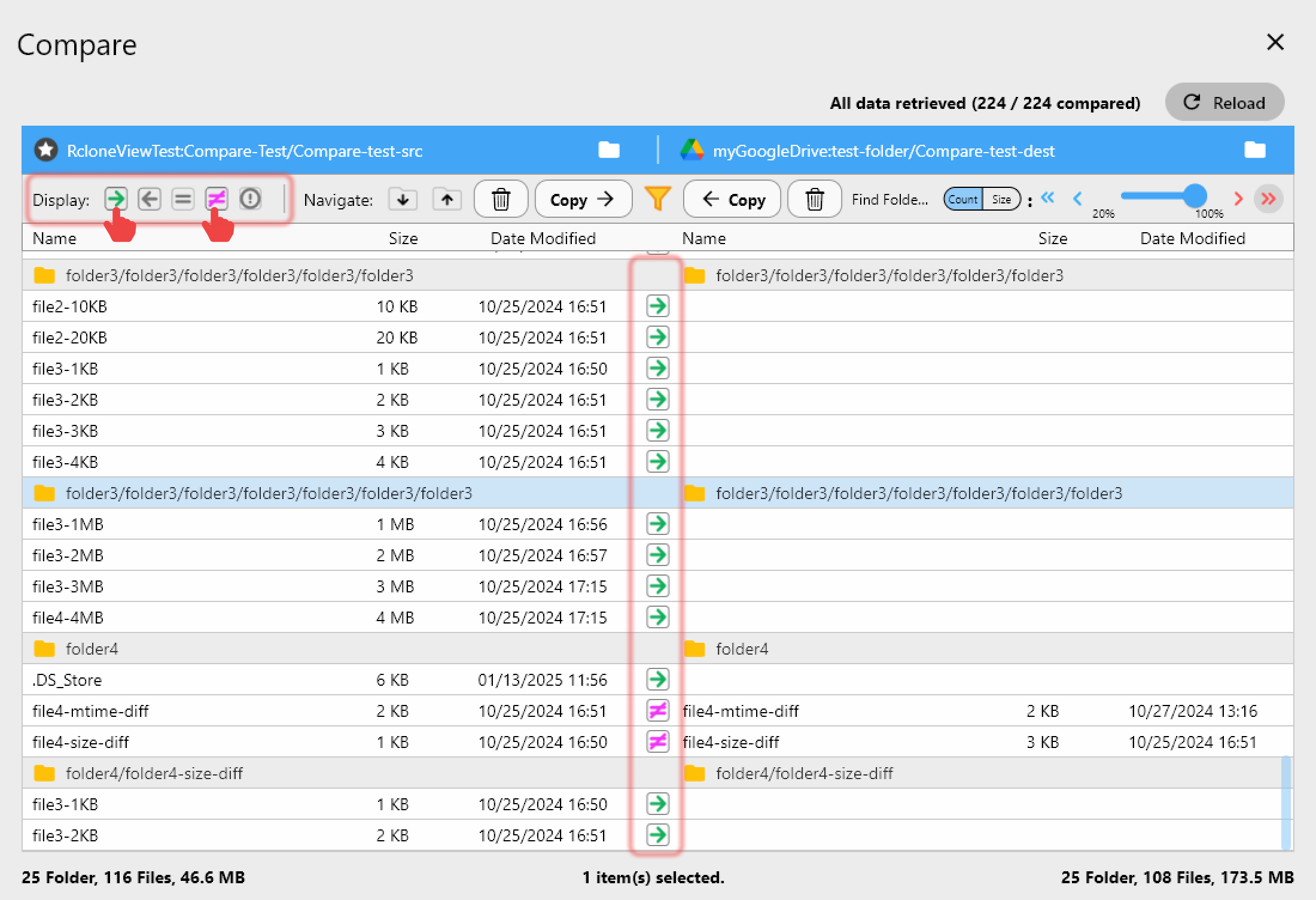
Folder Comparison with filters
Use Folder Comparison to see the state of your source and destination. Combined with filters, this helps you understand exactly what will be synced.
Common Mistakes
Forgetting the trailing ** for directories
# Wrong — only excludes a FILE named "logs"
--exclude "logs"

# Right — excludes the logs DIRECTORY and everything in it
--exclude "logs/**"
Including without excluding the rest
# This includes PDFs but doesn't exclude anything else
--include "*.pdf"

# This works — include already implies "exclude everything else"
# But only when using --include alone
Order matters
# This excludes everything, then tries to include (too late!)
--exclude "*"
--include "*.pdf"

# This works — include first, then exclude the rest
--include "*.pdf"
--exclude "*"
Getting Started
- Download RcloneView from rcloneview.com.
- Create a job with filter rules in the configuration.
- Dry run first to verify your filters catch the right files.
- Run the job once you're confident.
- Use filter-from files for complex, reusable rule sets.
Filters turn a blunt "sync everything" into a precise "sync exactly what I need." Master them once, use them everywhere.
Related Guides:
Supported Cloud Providers